
Stormwater design
In short: In Geelong, you typically need an OSD tank (on-site stormwater detention tank) when a multi-unit or other development will send more runoff to an existing drain than it was designed for. The tank holds runoff from roofs and paving and releases it slowly through an orifice, at no more than council's permissible site discharge. The City applies the Infrastructure Design Manual (IDM) and its own Design Note 2.
Key takeaways
- An OSD tank stores runoff and releases it through an orifice limited to the permissible site discharge (PSD), with an overflow for big storms.
- Geelong reads its Design Note 2 with the IDM; where the two conflict, the Design Note takes precedence.
- For sites up to about 1 ha with no council-set PSD, IDM Table 13 gives the discharge rate and the storage per square metre.
- Detention releases stormwater slowly through an orifice; retention keeps rainwater for toilets, washing machines and gardens. One tank can be set up for both.
- A buried tank is checked for soil, any traffic and groundwater uplift; when specific calculations are submitted, the IDM asks for its structural computations.
Building units or townhouses in Geelong with a stormwater detention requirement? Get a quote or call 03 4250 8105, and send your site plan and planning permit.
What is an OSD tank and how does it work?
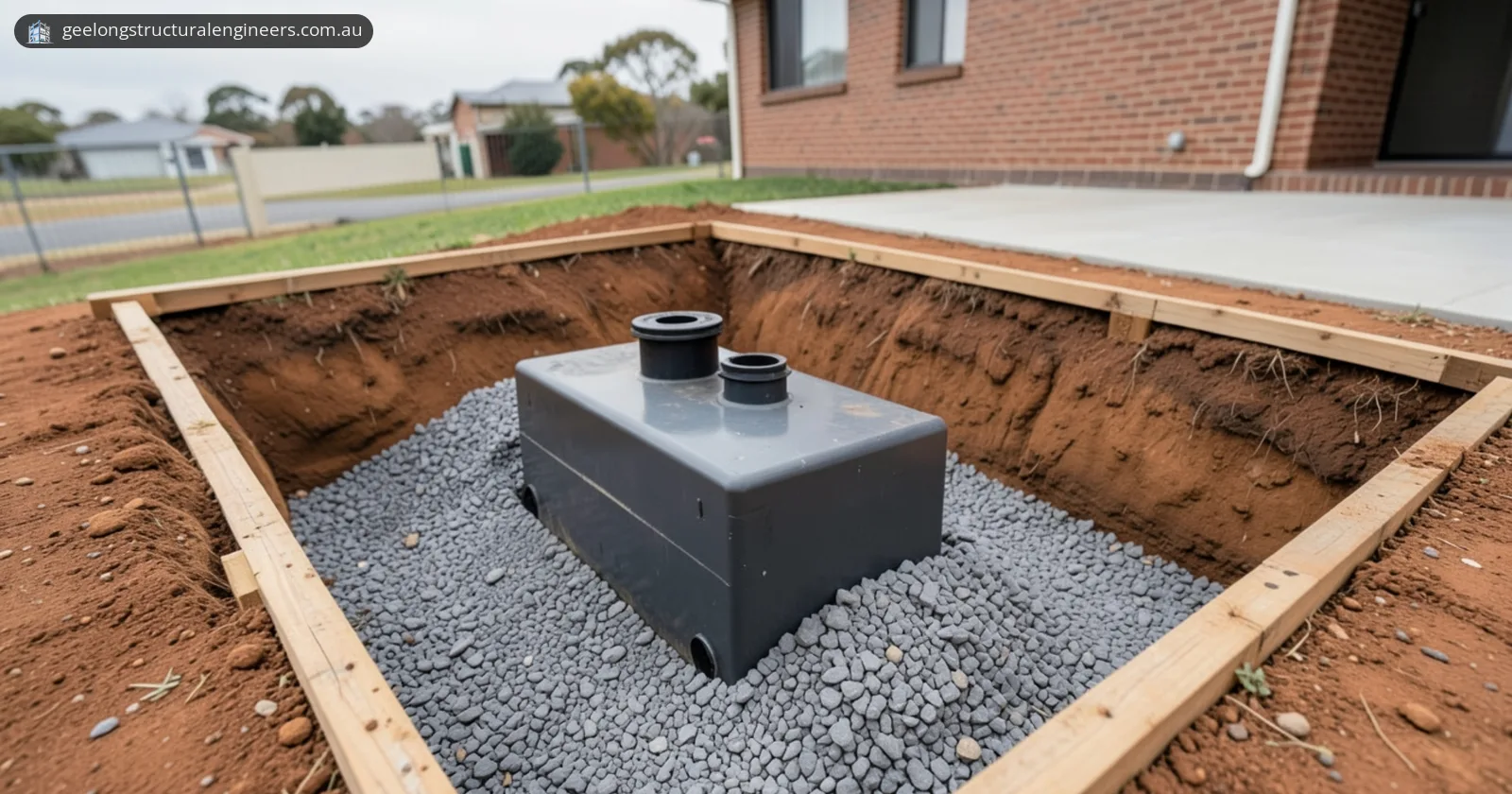
An OSD tank is on-site stormwater detention: a tank, pipe or pit system that holds runoff from a site's roofs and paving during a storm and releases it slowly to the council drain. The Infrastructure Design Manual (IDM), a joint initiative of Victorian rural and regional councils, says on-site detention aims to stop developments that add runoff from exceeding the capacity of existing drains.
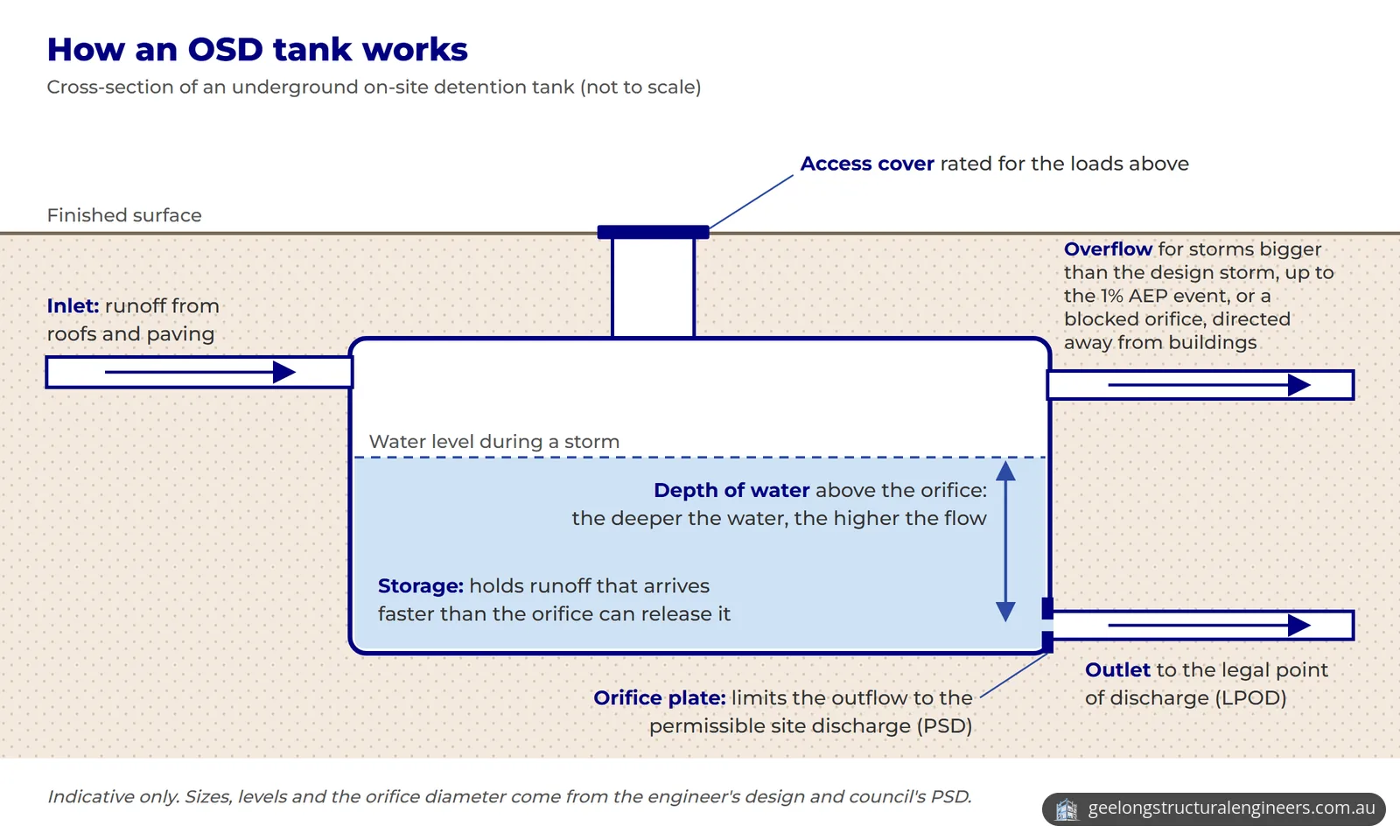
An OSD tank has three working parts:
- Storage. The tank holds runoff that arrives faster than the outlet can release it, then empties slowly, as Graf's technical guide for its Platin tank (sold in Australia through Reece) describes.
- Outflow control. The IDM lists a pipe, an orifice plate or a proprietary multi-cell unit as typical outflow controls. An orifice plate is a plate with a small hole sized for the permissible site discharge (PSD), the outflow rate council will accept. Graf's orifice table shows the flow through an orifice rising as the water above it gets deeper.
- Overflow. The IDM says a detention system should have an overflow for storms rarer than its design storm, up to and including the 1% Annual Exceedance Probability (AEP) event, and for blockages. A 1% AEP storm has a 1% chance of being exceeded in any year. Overflows should be directed away from buildings and neighbouring properties, and council will expect the designer to show the maximum water level stays at least 300 mm below the lowest floor of any home in the overflow zone.
When does the City of Greater Geelong require an OSD tank?
The City of Greater Geelong may require an OSD tank when a development will send more stormwater to an existing drain than that drain was designed to carry. Greater Geelong is one of the IDM's participating councils, and IDM Clause 19.2.1 lists the developments that typically need on-site detention:
- multi-unit development in newer residential areas where the drainage design made no specific provision for it;
- multi-unit development in older residential areas where the drains were designed for a peak flow significantly lower than the IDM's runoff coefficients give for a 20% AEP storm;
- industrial and major commercial development where the drains were designed for significantly lower peak flows;
- low-density residential development within or next to urban or rural township areas.
The IDM says on-site detention will not usually be required on rural lots over 2 ha, unless measures are needed to protect streams or constructed waterways from erosion.
The IDM raises on-site detention at the planning permit stage. Under Clause 3.3.4.3, even when council does not ask for a Stormwater Management Strategy, the developer should show that stormwater can reach the existing drains without harming how they operate, and this may require significant on-site detention.
The legal point of discharge (LPOD) is the discharge point council nominates for a site's stormwater. Under IDM Clause 21, council identifies legal points of discharge for all developments and may first assess the impact on existing drains; where a development is likely to affect them adversely, the works needed may include on-site detention.
How is an OSD tank sized in Geelong?
An OSD tank in Geelong is sized so the site's outflow at the LPOD stays within the PSD. Geelong's Design Note 2, revised in January 2023, says private lot-scale detention uses IDM Clause 19, Table 13 to determine the PSD at the LPOD. The note is read with the IDM, and where the two conflict, the note takes precedence.
Table 13's simplified method applies to sites of up to about 1 ha where council has not specified the PSD. Its multi-unit rows are:
| Multi-unit development (IDM Table 13) | Allowable discharge rate | Storage in a vertical tank or basin | Storage in horizontal pipes |
|---|---|---|---|
| Newer residential areas | 65 litres per second per hectare | 8 litres per m² | 10 litres per m² |
| Older residential areas | 37 litres per second per hectare | 12 litres per m² | 14 litres per m² |
In the IDM's worked example, a multi-unit development on a 750 m² site in an older area sends 60% of its runoff to rainwater tanks and 40% to underground pipes. Table 13 then asks for 0.6 × 750 × 12 = 5,400 litres in the tanks and 0.4 × 750 × 14 = 4,200 litres in the pipes.
Specific calculations by a qualified civil engineer are required when council's nominated peak discharge rates differ significantly from those the table assumes. For private detention on sites of up to 10 ha, Design Note 2 accepts the Modified Rational Method or hydrological routing. The IDM's council checklist then asks whether the orifice size has been calculated and whether storage is spread between pipes, pits and tanks in proportion to where the flow comes from.
Which OSD tank type suits the site?
The IDM's most commonly acceptable on-site detention systems include rainwater tanks, underground pipes and tanks, kerbed driveways and pumped systems, and the choice depends partly on site levels and the loads above.
| OSD option | What the sources say | Points to check |
|---|---|---|
| Above-ground rainwater tank | The IDM lists conventional rainwater storage tanks as an acceptable system | The IDM checklist asks whether the outlet could be made larger by making the tank lower and wider |
| Below-ground tank or pipes under a garden | The IDM lists underground pipes and tanks of various configurations | Graf's deepest installation is for green areas only, unless an engineered suspended slab is installed |
| Tank under a driveway | Graf's car-rated set-up uses a cast cover, with the riser collar supported on concrete; the IDM asks for pit covers rated for the potential traffic loads | Graf's car-rated set-up is for passenger cars up to 3.5 tonnes; surfaces used by heavier vehicles stay at least the trench depth away |
| Kerbed driveway storage | The IDM accepts driveways bounded by kerbs at least 100 mm wide | The IDM asks for evidence that habitable floors are at least 300 mm above the peak water level |
What loads does a buried OSD tank have to carry?
A buried OSD tank has to carry the soil around and above it, any vehicles over or beside it, and the upward push of groundwater when it is empty. When specific calculations are submitted, the IDM asks for structural computations for any underground storage tank and cross-sections of each storage device.
- Soil and slopes. Before installation, Graf's guide asks for checks of the ground's structural suitability (it recommends a geotechnical report), the maximum groundwater level and the expected loads, such as traffic. A tank within 5 m of a slope or mound needs a statically calculated supporting wall to take the soil pressure.
- Groundwater uplift. Contech, a US manufacturer, explains that an empty tank in saturated ground is pushed up by the weight of the water it displaces. Soil cover, the tank's own weight, a reinforced concrete pad above it or concrete anchors can hold it down. Graf sets a maximum groundwater immersion depth for each tank size and recommends draining water away from tanks in clay or other water-tight soils.
What is the difference between detention and retention?
Detention holds stormwater during a storm and releases it slowly at a controlled rate; retention keeps rainwater on site for use.
| Detention (OSD) | Retention (rainwater reuse) | |
|---|---|---|
| Purpose | Limit the site's peak outflow to the PSD (IDM Clause 19) | Reduce the runoff volume and pollutant loads leaving the site (IDM Clause 20.3.10) |
| After the storm | Drains slowly through the outflow control | Stays in the tank for flushing toilets, filling washing machines and watering gardens (Graf) |
One tank can do both. Graf's guide says a correctly sized and set-up tank can detain the volume council requires and also retain rainwater for use, and it ties the detention volume to the orifice height in the tank.
When to call a structural engineer
Call an engineer as soon as council or a planning permit asks for on-site detention, because the IDM expects the designs and calculations to come from a qualified civil engineer and to be approved by council's engineering department. Call one early when:
- the tank will sit under a driveway or car park, or near heavy vehicles;
- the site has high groundwater, clay soils, or a slope within 5 m of the tank;
- one tank is meant to handle both detention and rainwater reuse.
Our civil engineering page covers design and documentation for on-site detention (OSD) and on-site retention (OSR) systems. Our residential stormwater page covers drainage designs for single dwellings and multi-unit developments, which may include detention systems, rainwater storage and pumps. Our page on stormwater and drainage issues causing structural damage explains how water collecting around footings can soften the soil and lead to settlement and cracking.
Frequently asked questions
Who maintains an OSD tank after the units are sold?
The landowners do. The IDM says council and the developer may enter a Section 173 Agreement that binds future landowners to keep the system working, give council officers reasonable access to inspect it, and possibly pay an annual inspection fee. Its standard agreement also says the owner must not modify the system without council's written agreement.
Can council waive the need for on-site detention?
In some cases, yes. IDM Clause 19.3.4 says council's engineering department may waive on-site detention where it can be shown that the extra stormwater from the development causes no adverse impacts and council's level of service will not be compromised.
What if the site sits lower than the street?
A pump may be needed. The IDM says pumping may become the only viable option when a site is below street level and no drainage network runs along the rear boundary. Small pumped systems serving catchments of up to 2,000 m² where stormwater can't reach the legal point of discharge by gravity may be designed to Section 9 of AS/NZS 3500.3; council expects other pumped systems to be designed by a qualified engineer.
What happens if the orifice blocks?
Where the orifice or tube sits on the downstream face of a pit, the IDM expects the designer to deal with a blockage in a design storm. Its options include a safe overland route for the surplus flow, enough storage to keep the flow on site, or a dual-chamber pit with the controlled flow passing an internal weir wall.
What does council need to nominate the point of discharge for a dwelling?
The IDM lists a plan of the proposed development showing its pervious and impervious areas, existing and proposed surface levels at intervals of no more than 10 m, and the location and size of existing drains and easements in and next to the site.
Sources
- Local Government Infrastructure Design Association: Infrastructure Design Manual (IDM) Version 5.6, December 2025 (PDF)
- City of Greater Geelong: Stormwater Detention Storage Design (Design Note 2)
- Local Government Infrastructure Design Association: Participating Councils
- Local Government Infrastructure Design Association: About the IDM
- Graf Platin Storm Water Detention & Retention: Installation Instructions & Technical Information (Reece, PDF)
- Contech Engineered Solutions (USA): Staying Grounded, buoyancy of underground tanks (2020)
More articles
Permits and approvals
Do you need section 29A consent to demolish a building in Victoria?
Section 29A of Victoria's Building Act 1993 needs council consent for a demolition permit if over half the volume or any part of a street facade goes.
Permits and approvals
Do you need an occupancy permit or a certificate of final inspection in Victoria?
A Victorian occupancy permit is needed before anyone lives in a new home. House extensions, garages and pools get a certificate of final inspection.